

The Calliope mini at School
As an educational tool, the Calliope mini enables the transition from passive consumer to active creator.
From Understanding to Creating
The primary goal when working with the Calliope mini is to develop a deep understanding of how digital processes work. Instead of viewing technology as a “black box,” learners explore the logic behind it. This approach makes processes understandable and creates the necessary foundation for creative, problem-solving-oriented thinking.
The Calliope mini enables curriculum-based, hands-on teaching across all types of schools and grade levels. As an important component of computer science education, it particularly fosters competencies in the areas of programming, algorithms and data processing, as well as artificial intelligence and robotics. Beyond that, the Calliope mini can be used across subjects – for example in technology, physics, and biology, as well as in aesthetic subjects such as music and art.
The didactic concept of the Calliope mini is based on the principle of "low floor, high ceilings, wide walls", enabling its use across different grade levels and supporting a range of learning levels.
Low Floor: Thanks to integrated sensors and intuitive programming interfaces, even beginners with no prior knowledge can quickly get started.
High Ceilings: The Calliope mini is designed to be open and offers the possibility of realizing challenging, advanced projects.
Wide Walls: The versatile sensors and interfaces of the Calliope mini enable an enormous range of creative applications – from musical instruments and environmental measurements to AI applications.

In Secondary School
Together with its associated extensions, the Calliope mini offers the opportunity to explore the digital world and, beyond that, to understand it sustainably and actively help shape it. Teaching with the Calliope mini is aligned with the computer science education standards for lower and upper secondary education.

The following section assigns the use of the Calliope mini to the individual process areas.
When learning with the Calliope mini, students learn to translate real-world situations into formal models and then turn them into functioning programs. They analyze a specific situation, identify relevant processes, conditions, and inputs, and represent them using algorithms, sensors, variables, or loops. In this way, an idea or everyday problem becomes a structured model that can be programmed, tested, and further developed. The Calliope mini makes this process directly tangible, as digital models can be made visible, audible, or measurable right away.
When learning with the Calliope mini, students learn to recognize, describe, and interpret computer science concepts in different forms of representation. For example, students experience programs as block code, text code, process descriptions, circuit diagrams, or as concrete responses from the Calliope mini. This helps them understand how inputs, processing, and outputs are connected and how a program’s behavior can be derived from individual instructions. The Calliope mini makes abstract computer science concepts immediately visible and practically testable.
When learning with the Calliope mini, students learn not only to use computer science systems, but also to question them critically. Through their own programs and concrete projects, they explore issues relating to data protection, responsibility, and the social impact of digital technologies. For example, they consider what data sensors collect, how this data is processed, and what consequences automated decisions can have. In this way, the Calliope mini offers a hands-on approach to evaluating algorithms, technical systems, and their use in a reasoned way.
When learning with the Calliope mini, students learn to structure information meaningfully and recognize connections between different systems. They break tasks down into individual steps, organize inputs, processing operations, and outputs, and relate them to one another. In doing so, it becomes clear how sensors, programs, actuators, and external devices work together. The Calliope mini makes this interconnectedness practically tangible and supports learners in planning, understanding, and further developing complex processes in a clear and organized way.
When learning with the Calliope mini, students learn to work together on projects and communicate their ideas clearly. They plan, program, test, and improve them as a team. Through discussion of program sequences, errors, and program development, they increasingly use computer science terminology confidently and correctly. The Calliope mini supports collaborative work because results become directly visible and can be discussed, reviewed, and further developed together.
The task can be differentiated through appropriately designed subtasks along the three requirement areas of reproduction, reorganization and transfer, and reflection and problem-solving. The teaching material enables connections to the content areas of the computer science education standards, in particular to information and data, algorithms, languages and automata, computer science systems, and computer science, humans, and society.

In Primary School
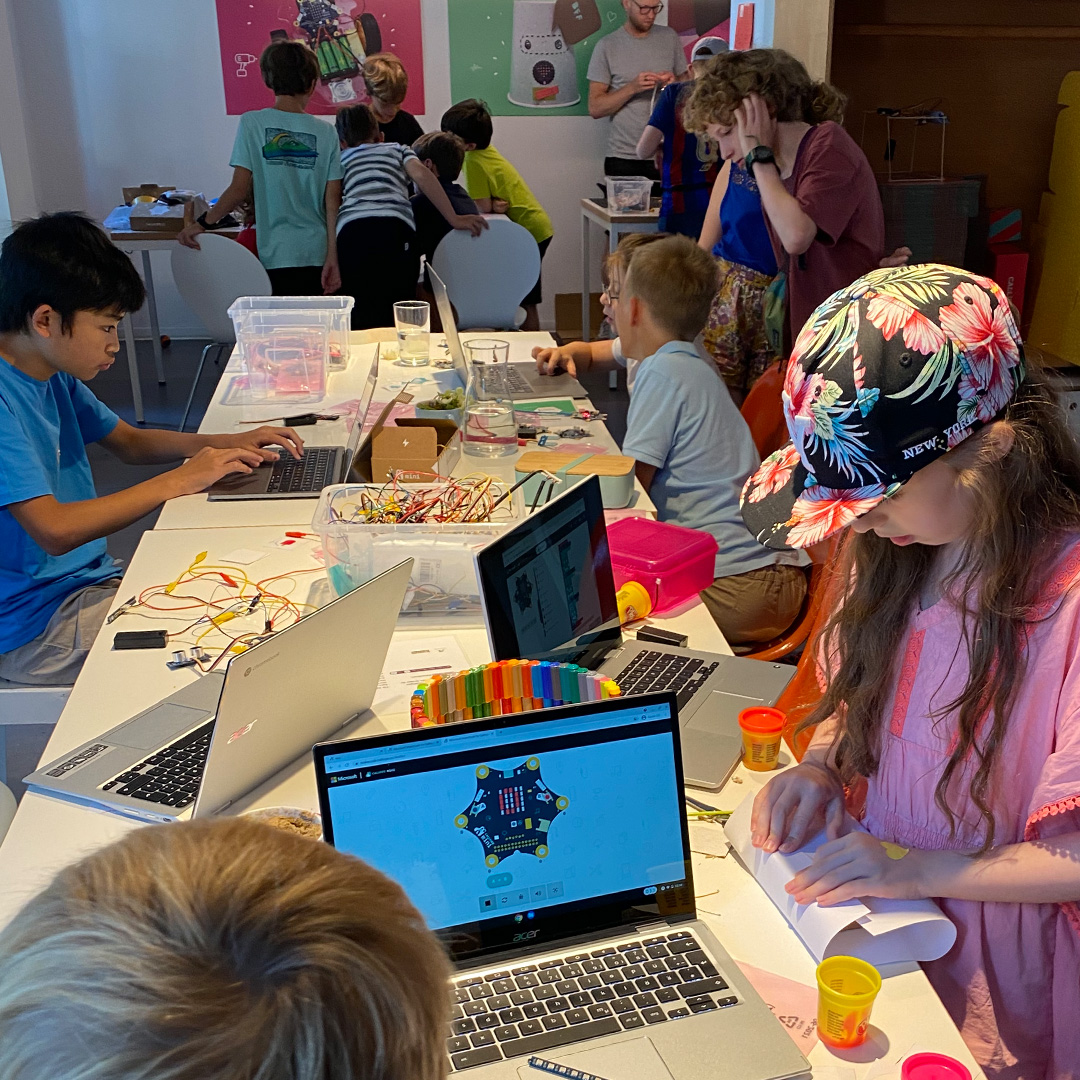
For primary school, the Calliope mini opens up an age-appropriate, hands-on approach to digital media education and computer science education across subjects. Projects with the Calliope mini connect to children’s everyday lives and experiences and support them in not only using digital technologies, but also exploring basic principles and making sense of digital experiences. In doing so, students experience self-efficacy: they develop their own ideas, implement them, and reflect on their results.
The Calliope mini and accessories can be purchased directly via the Calliope Online Shop or through one of our official partners.
Buy Calliope mini