

Artificial Intelligence (AI) is emerging as a key technology of our time. To prepare students for the digital future, a fundamental understanding of AI is necessary.
The Calliope mini offers fantastic opportunities to dive into the topic of Machine Learning and AI in a hands-on way.
AI-Analog
How do machines make decisions?
Through the Naughty Figure-Nice Figure Game, classification with decision trees becomes tangible. Learners take on the roles of data, algorithms, or machines themselves. This creates a practical understanding of AI that encourages discussion about the opportunities and limitations of the technology.
Step-by-step instructions and source:
AI Unplugged by Annabel Lindner and Stefan Seegerer
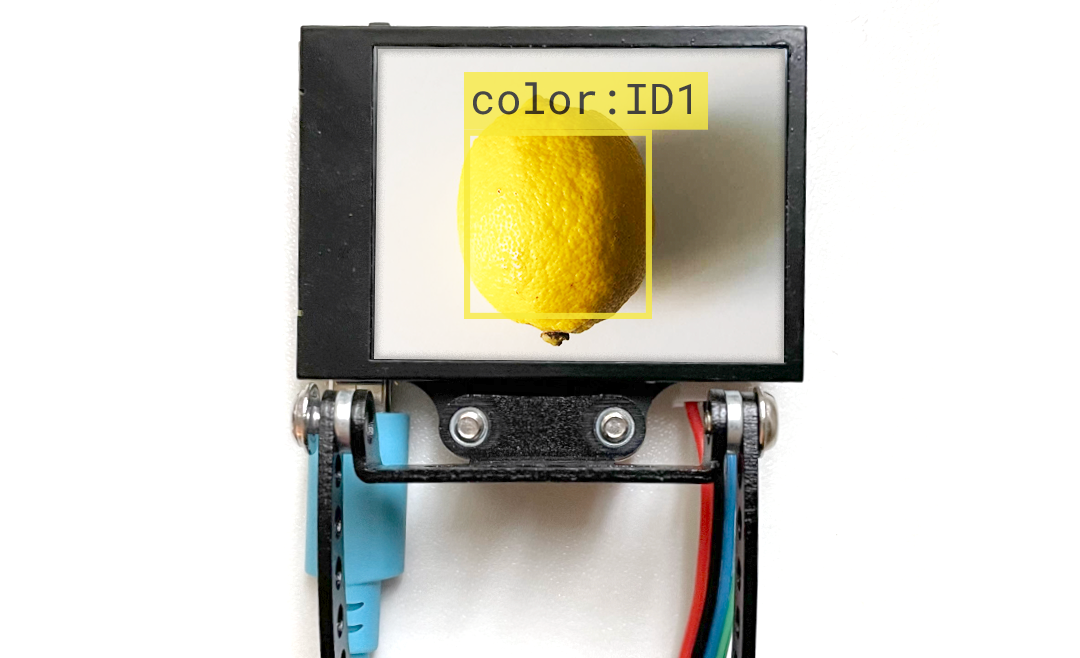
Huskylens
The HuskyLens is an intelligent camera.
Different modes enable projects on object recognition, face recognition, line or color recognition. Using the integrated buttons and display, users can "teach" patterns and try them out immediately. It connects to the Calliope mini via the Grove connector, making it ideal for creative projects in robotics and introductory AI.
AI Training
Was that a proper push-up or was that cheating?
With simple exercises and projects in the field of machine learning, movement patterns are recorded, custom models are trained, and applied in prototypes. The Calliope mini enables visible monitoring and an engaging way to process data and make it tangibly experienceable.
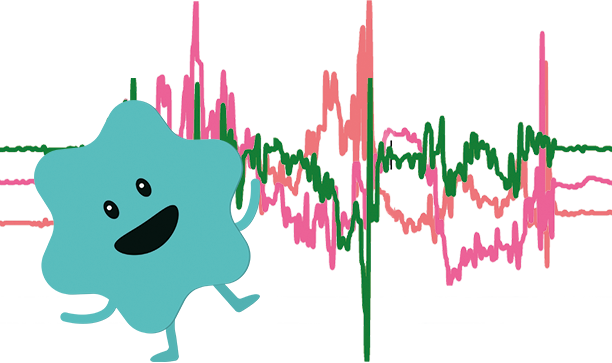
Calliope x Teachable Machine
Calliope Teachable Machine is a web app that allows you to train a model, program it directly, and immediately use it in application.

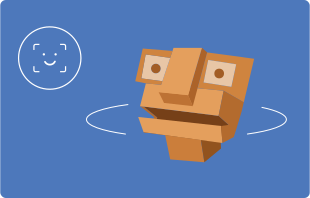
Face Robot - Face Recognition
The Face Tracking App allows you to control any Calliope mini robot using your face position, rotation, or even by opening your mouth.
The app is available as a web app that runs in the browser and communicates with your Calliope mini via Bluetooth.

Schedule Overview
Systems that perform tasks that would otherwise require human intelligence.
A clear step-by-step instruction for solving a problem.
A representation of a relationship "learned" from data that makes predictions/decisions.
Information used to train or test models.
An organized collection of data for training/testing.
A measurable property of a data object (e.g., pixel value, word).
The correct assignment in training data (e.g., "cat"/"dog").
A subfield of AI in which models learn from examples.
Learning with labeled examples.
Finding patterns without labels (e.g., clustering).
Learning through rewards/penalties for actions.
A model built from "neurons" (nodes) and layers.
A neural network with many layers (deep networks).
The phase in which the model learns from data.
Checking how well the model performs on new data.
The model memorizes training data but fails on new data.
The model applies what it learned to unknown examples.
Assignment to categories.
Prediction of a numerical value.
Applying a trained model to new inputs.
An input instruction/command to a language or image model.
AI that processes/generates text (e.g., chatbots).
Recognizing object categories in images.
Converting spoken language into text.
AI that creates new data (text, image, audio).
Systematic error due to unbalanced data and/or methods.
The ability to explain a model's decisions.
Avoiding unfair favoritism/disadvantage by AI.
Protection of personal data (e.g., GDPR).
Rights to a work; relevant for training/use of generated content.
Stability against disturbances/attacks.
Plausible-sounding but incorrect output.
Responsible, safe use of AI in society.
A field where AI is used (e.g., medicine, transportation, education).
Feedback cycle: results influence future data/decisions.
The amount of text/information an LLM can consider at once.
A text unit that LLMs compute with (word part/word).
Additional training of a model on specific tasks/data.
Rules/guardrails that limit the use of AI.